Inspired by the Innovative Farmers flax field lab, Amy Cartwright set out to grow her own flax at an allotment in Bristol.
Combining her two passions - growing food and making clothes - Amy became fascinated this year at the thought of growing her own textile fibre. Popping up in pockets of the UK are funded projects where communities have come together to grow flax to produce linen. Amy works in Policy and Standards at Soil Association, and was given some leftover seed from the Innovative Farmers flax growing trial, so wanted to give it a go in her own allotment!
"I sowed the seed in one of the raised beds on my plot at Alderman Moores (Bristol) in April and watched in awe as it grew into tall slender plants. Apart from initial watering, and weeding around the seedlings, it was the most low-maintenance crop on the plot. I was convinced in the summer drought it wouldn’t last but it turns out flax has a long fibrous root system and is an excellent drought-tolerant plant to grow. One for a changing climate, perhaps? Neither did it suffer from any pests and diseases. A wonder crop! Linum usitatissimum means ‘most useful’."
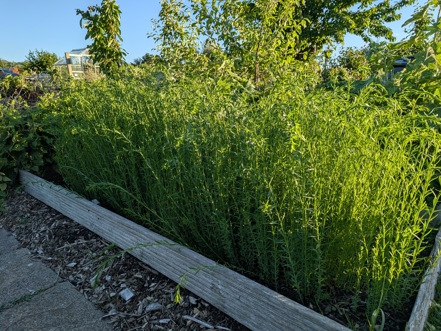

"The beautiful blue flowers came and went, and the seeds formed and the stems dried and turned brown; time came to turn it into fibre. I pulled the plant up and stripped off most of the seeds (‘rippling’) and placed the stems on the bed to ‘dew ret’ or ‘field ret’ which is where you let the stems break down naturally by the weather."
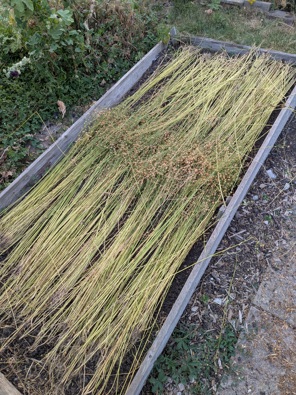 Field retting
"We had very little rain, but the sun and the morning dew did the trick. After 4-6 weeks I bundled them up to dry at home in the baking sun of our south-facing garden. Once thoroughly dried, the next steps are ‘breaking’ (breaking the wood stalks), ‘scutching’ (beating the stalks against a board to remove the woody parts), and ‘hackling’ (combing out the fibre). The hackling stage produced long-line fibre, which is best quality, and ‘tow’ which is shorter brittle pieces. Tow traditionally would have gone into making coarser yarns for products such as rope or twine, whereas long line would be used in fine textiles (table linens and sewing thread)."
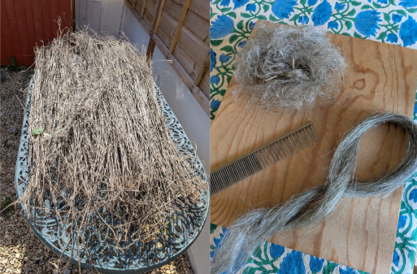
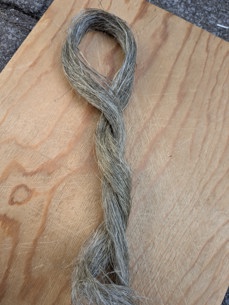
Amy is now at the stage where she can wind it onto a ‘distaff’ and spin it. Having only attempted spinning once before using a spinning wheel (and it's an incredibly skilled process!), she is taking part in a spinning workshop with Flaxland, based in Stroud, for this final stage.
To find out more about the Innovative Farmers Flax field lab, visit: Growing flax for regenerative textiles.
More details about Amy's allotment association in Bristol can be found online here: https://hwdaa.co.uk/.
Lastly, details of Flaxland, based in Stroud, are online here: https://www.flaxland.co.uk/
Related news

13 January 2026
UK fibres
Growing flax for regenerative textiles: field lab update

30 August 2023
Novel crops and plant breeding
Harvesting flax and the future of linen fibre in Scotland

28 March 2024
UK fibres